bmsspy
BMSSPy


A pure python bmssp implementation.
Setup
Make sure you have Python 3.11.x (or higher) installed on your system. You can download it here.
Installation
pip install bmsspy
Documentation
- Github: https://github.com/connor-makowski/bmsspy
- Docs: https://connor-makowski.github.io/bmsspy/bmsspy.html
- Paper: https://ssrn.com/abstract=5777186
How to Cite BMSSPy in your Research
If you use BMSSPy for your research, please consider citing the following paper:
Makowski, Connor and Guter, Willem and Russell, Tim and Saragih, Austin, BMSSPy: A Python Package and Empirical Comparison of Bounded Multi-Source Shortest Path Algorithm (November 19, 2025). MIT Center for Transportation & Logistics Research Paper No. 2025/034, Available at SSRN: https://ssrn.com/abstract=5777186
Or by using the BibTeX entry:
@article{makowski2025bmsspy,
  title={BMSSPy: A Python Package and Empirical Comparison of Bounded Multi-Source Shortest Path Algorithm},
  author={Makowski, Connor and Guter, Willem and Russell, Tim and Saragih, Austin},
  journal={MIT Center for Transportation & Logistics Research Paper Series},
  number={2025-034},
  year={2025},
  url={https://ssrn.com/abstract=5777186}
}
Use
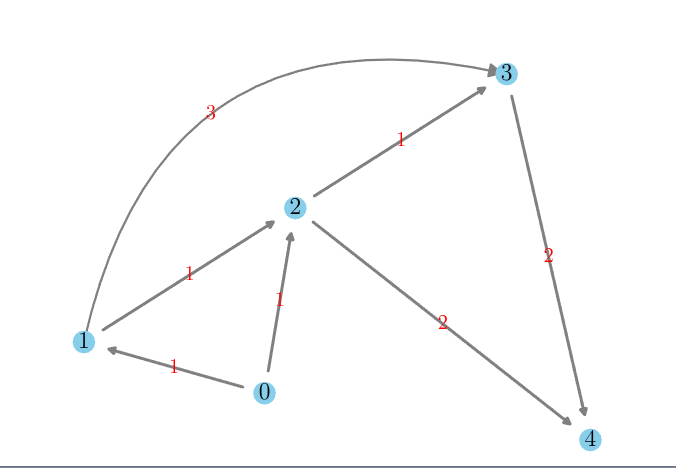
The example use cases in this section are based on the following graph:
from bmsspy import Bmssp

# Graph with 5 nodes: 0..4
# Adjacency-list representation with nonnegative weights
graph = [
    {1: 1, 2: 1},   # 0 -> 1 (1), 0 -> 2 (1)
    {2: 1, 3: 3},   # 1 -> 2 (1), 1 -> 3 (3)
    {3: 1, 4: 2},   # 2 -> 3 (1), 2 -> 4 (2)
    {4: 2},         # 3 -> 4 (2)
    {}              # 4 has no outgoing edges
]

bmssp_graph = Bmssp(graph) # Initialize the graph as a Bmssp graph

# Distances and predecessors from origin 0
res_0 = bmssp_graph.solve(origin_id=0)
print(res_0) #=>
# {
#     'origin_id': 0,
#     'destination_id': None,
#     'predecessor': [-1, 0, 0, 2, 2],
#     'distance_matrix': [0.0, 1.0, 1.0, 2.0, 3.0],
#     'path': None,
#     'length': None
# }

# Shortest path from 0 to 4
res_0_4 = bmssp_graph.solve(origin_id=0, destination_id=4)
print(res_0_4) #=>
# {
#     'origin_id': 0,
#     'destination_id': 4,
#     'predecessor': [-1, 0, 0, 2, 2],
#     'distance_matrix': [0.0, 1.0, 1.0, 2.0, 3.0],
#     'path': [0, 2, 4],
#     'length': 3
# }
In the example above, we only use a single orign, however multiple origins are supported if passed as a set:
# Pass orgin_id as a set of ids
res_02 = bmssp_graph.solve(origin_id={0,2})
print(res_02) #=>
# {
#     'origin_id': [0, 2],
#     'destination_id': None,
#     'predecessor': [-1, 0, -1, 2, 2],
#     'distance_matrix': [0.0, 1.0, 0.0, 1.0, 2.0],
#     'path': None,
#     'length': None
# }
By default graphs that are given are converted to constant degree such that worst case asymtotic run times are based on the constant degree converted graphs. Before returning a result, the constant degree conversion is undone such that the results are in the original passed graph format.
Most real world graphs are not constant degree. Converting to constant degree graphs can add substantial operational overhead during pre and post processing as well as during the actual algorithmic runtime.
To skip the constant degree conversion:
# Set use_constant_degree_graph=False
bmssp_graph = Bmssp(graph=graph, use_constant_degree_graph=False)
Contributing
Contributions are welcome! Please open an issue or submit a pull request.
Development
To avoid extra development overhead, we expect all developers to use a unix based environment (Linux or Mac). If you use Windows, please use WSL2.
For development, we use uv to manage dependencies and run tests.
Making Changes
1) Fork the repo and clone it locally. 2) Make your modifications. 3) Run tests and make sure they pass. 4) Prettify your code. 5) DO NOT GENERATE DOCS. - We will generate the docs and update the version number when we are ready to release a new version. 6) Only commit relevant changes and add clear commit messages. - Atomic commits are preferred. 7) Submit a pull request.
Development Commands
| Command | What it does |
|---|---|
uv run nox |
Run tests across Python 3.11, 3.12, 3.13, 3.14 |
uv run nox -s tests-3.14 |
Run tests on a single Python version |
uv run pytest |
Run tests in the local venv |
uv run pytest -v |
Run tests with verbose output |
uv run python utils/prettify.py |
Format with autoflake + black |
Dev dependencies are in [project.optional-dependencies] dev in pyproject.toml. Install with uv sync --extra dev.
1""" 2# BMSSPy 3[](https://badge.fury.io/py/bmsspy) 4[](https://opensource.org/licenses/MIT) 5<!-- [](https://pypi.org/project/bmsspy/) --> 6 7A pure python bmssp implementation. 8 9# Setup 10 11Make sure you have Python 3.11.x (or higher) installed on your system. You can download it [here](https://www.python.org/downloads/). 12 13### Installation 14 15``` 16pip install bmsspy 17``` 18 19### Documentation 20 21- Github: https://github.com/connor-makowski/bmsspy 22- Docs: https://connor-makowski.github.io/bmsspy/bmsspy.html 23- Paper: https://ssrn.com/abstract=5777186 24 25### How to Cite BMSSPy in your Research 26 27If you use BMSSPy for your research, please consider citing the following paper: 28 29> Makowski, Connor and Guter, Willem and Russell, Tim and Saragih, Austin, BMSSPy: A Python Package and Empirical Comparison of Bounded Multi-Source Shortest Path Algorithm (November 19, 2025). MIT Center for Transportation & Logistics Research Paper No. 2025/034, Available at SSRN: https://ssrn.com/abstract=5777186 30 31Or by using the BibTeX entry: 32 33``` 34@article{makowski2025bmsspy, 35 title={BMSSPy: A Python Package and Empirical Comparison of Bounded Multi-Source Shortest Path Algorithm}, 36 author={Makowski, Connor and Guter, Willem and Russell, Tim and Saragih, Austin}, 37 journal={MIT Center for Transportation & Logistics Research Paper Series}, 38 number={2025-034}, 39 year={2025}, 40 url={https://ssrn.com/abstract=5777186} 41} 42``` 43 44### Use 45 46The example use cases in this section are based on the following graph: 47 48 49 50```python 51from bmsspy import Bmssp 52 53# Graph with 5 nodes: 0..4 54# Adjacency-list representation with nonnegative weights 55graph = [ 56 {1: 1, 2: 1}, # 0 -> 1 (1), 0 -> 2 (1) 57 {2: 1, 3: 3}, # 1 -> 2 (1), 1 -> 3 (3) 58 {3: 1, 4: 2}, # 2 -> 3 (1), 2 -> 4 (2) 59 {4: 2}, # 3 -> 4 (2) 60 {} # 4 has no outgoing edges 61] 62 63bmssp_graph = Bmssp(graph) # Initialize the graph as a Bmssp graph 64 65# Distances and predecessors from origin 0 66res_0 = bmssp_graph.solve(origin_id=0) 67print(res_0) #=> 68# { 69# 'origin_id': 0, 70# 'destination_id': None, 71# 'predecessor': [-1, 0, 0, 2, 2], 72# 'distance_matrix': [0.0, 1.0, 1.0, 2.0, 3.0], 73# 'path': None, 74# 'length': None 75# } 76 77# Shortest path from 0 to 4 78res_0_4 = bmssp_graph.solve(origin_id=0, destination_id=4) 79print(res_0_4) #=> 80# { 81# 'origin_id': 0, 82# 'destination_id': 4, 83# 'predecessor': [-1, 0, 0, 2, 2], 84# 'distance_matrix': [0.0, 1.0, 1.0, 2.0, 3.0], 85# 'path': [0, 2, 4], 86# 'length': 3 87# } 88``` 89 90In the example above, we only use a single orign, however multiple origins are supported if passed as a set: 91 92```python 93# Pass orgin_id as a set of ids 94res_02 = bmssp_graph.solve(origin_id={0,2}) 95print(res_02) #=> 96# { 97# 'origin_id': [0, 2], 98# 'destination_id': None, 99# 'predecessor': [-1, 0, -1, 2, 2], 100# 'distance_matrix': [0.0, 1.0, 0.0, 1.0, 2.0], 101# 'path': None, 102# 'length': None 103# } 104``` 105 106By default graphs that are given are converted to constant degree such that worst case asymtotic run times are based on the constant degree converted graphs. Before returning a result, the constant degree conversion is undone such that the results are in the original passed graph format. 107 108Most real world graphs are not constant degree. Converting to constant degree graphs can add substantial operational overhead during pre and post processing as well as during the actual algorithmic runtime. 109 110To skip the constant degree conversion: 111```python 112# Set use_constant_degree_graph=False 113bmssp_graph = Bmssp(graph=graph, use_constant_degree_graph=False) 114``` 115 116 117 118# Contributing 119 120Contributions are welcome! Please open an issue or submit a pull request. 121 122## Development 123 124To avoid extra development overhead, we expect all developers to use a unix based environment (Linux or Mac). If you use Windows, please use WSL2. 125 126For development, we use [uv](https://docs.astral.sh/uv/) to manage dependencies and run tests. 127 128## Making Changes 129 1301) Fork the repo and clone it locally. 1312) Make your modifications. 1323) Run tests and make sure they pass. 1334) Prettify your code. 1345) **DO NOT GENERATE DOCS**. 135 - We will generate the docs and update the version number when we are ready to release a new version. 1366) Only commit relevant changes and add clear commit messages. 137 - Atomic commits are preferred. 1387) Submit a pull request. 139 140## Development Commands 141 142| Command | What it does | 143|---|---| 144| `uv run nox` | Run tests across Python 3.11, 3.12, 3.13, 3.14 | 145| `uv run nox -s tests-3.14` | Run tests on a single Python version | 146| `uv run pytest` | Run tests in the local venv | 147| `uv run pytest -v` | Run tests with verbose output | 148| `uv run python utils/prettify.py` | Format with autoflake + black | 149 150Dev dependencies are in `[project.optional-dependencies] dev` in `pyproject.toml`. Install with `uv sync --extra dev`. 151""" 152 153from bmsspy.entrypoint import Bmssp